

What the profiles contain
Every published company profile was read for an AI operating practice: a described way the company uses AI in how work, hiring, or decisions run. Product category labels are not that.
This overview was reconciled on 1 November 2026 with the nine company profiles. No additional company case was established by this review. The source accounts retain their original publication dates. The counts describe this site's evidence, not how many companies use AI or which company gets the most value from it.
| Company | In the published profile |
|---|---|
| Shopify | Yes. An April 2025 resourcing rule, and 2026 accounts of shared AI work. |
| Zapier | Yes. A capability program that reaches hiring, onboarding, and performance. |
| Buffer | Yes. An August 2026 Build Week of AI-assisted projects. |
| GitHub | Yes. Human-directed agent pull requests, shared analytics and evaluation gates. |
| Automattic | Yes. Role-specific literacy, documentation approval and support evaluation with named owners. |
| Basecamp | Yes. Prompt-first development, with senior review of Ruby or JavaScript changes from designers or junior programmers. |
| Todoist (Doist) | Yes. A company-wide shared AI workspace called DoistOS. |
| GitLab | Yes. A central AI platform team, functional owners, champions, and role-specific training. |
| Linear | Yes. Issue-attached agent work, bounded recurring delegation and human review. |
| Wolfram | No documented internal AI operating practice. |
Shopify: a resourcing rule and shared work
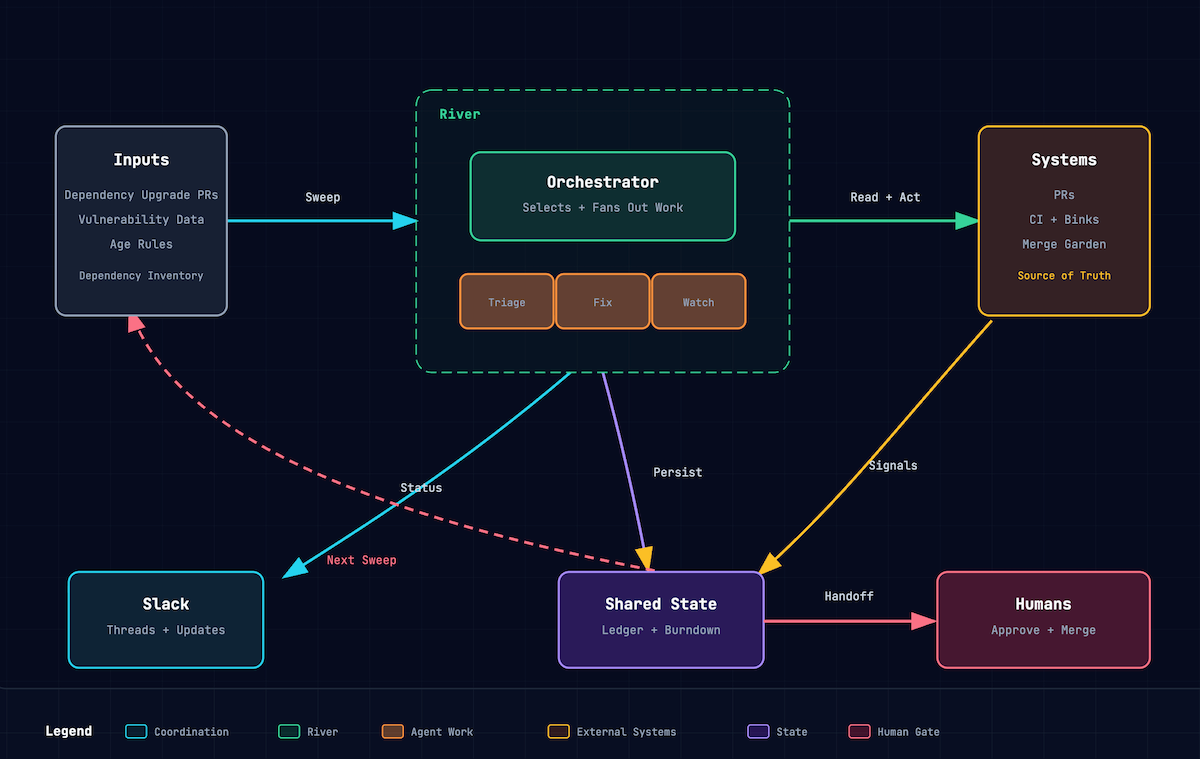
An October 22 mobile-engineering account adds shared simulator previews and overnight agent pull requests with engineer review and failure feedback. The reported rise from 6% to 61% concerns River’s share of merged mobile pull requests, not company-wide adoption or a measured productivity gain. (Company account.)
Shopify’s profile documents AI in resourcing, shared work, and review. These are company accounts, not an independent measure of productivity.
The resourcing rule
In April 2025, Tobi Lütke made reflexive AI use a baseline expectation. Teams asking for more headcount had to show why AI could not meet the need. AI use went into performance and peer reviews. The profile reads this as a planning constraint, not a tooling suggestion. The instrument was a founder memo, the same form Shopify has used for other resets. (Wall Street Journal, 8 April 2025, as cited on the Shopify profile.)
Shared work, with the decision left to a person
River is an AI agent used in shared Slack channels rather than private messages. Teammates can join the threads, and the work stays searchable. At publication on 28 May 2026, Shopify reported that River coauthored one in eight merged pull requests. The profile treats that as contribution share, not a causal productivity gain. (Under the River.)
Quick, documented 10 June 2026, is the internal host for interactive tools and other web artifacts. Shopify reported more than 50,000 created sites and participation from over half its employees, with sites accessible to all employees. Those figures are dated and company-reported. (Quick.)
A 2 September 2026 security account keeps the decision with engineers. River validates findings against current code, keeps the investigation in a shared thread, and escalates approval and merging to engineers. After merge, it checks whether the vulnerability is resolved. (How River takes security work from a fix to merge.)
The September Helix account adds checkpointed app migration: behavior tests, visual review, two independent agent code reviews, and engineer approval by default. Engineers can choose autonomous mode; the other gates still apply. (Helix.)
The remediation account also distinguishes prompted boundaries from enforced controls. It reports incomplete enumeration in one run and calls for deterministic checks around closure, pagination, deduplication and current-head accounting. The described review boundary is not a guarantee supplied by a prompt alone. (Same remediation account.)
Zapier: fluency becomes a people process
An October 29 COO account describes daily tool/model usage reports, allocation checks, rule-driven budget increases, and manager escalation. It adds a spend-governance example; it does not establish savings or return on investment. (Company account.)
Zapier’s January 2026 account describes early experiments that became a company-wide program. It reports daily-work AI usage of 63% in late 2023, 77% at the end of 2024, and 97% more recently. In March 2026 the company reported 100% adoption. The posts do not establish a shared denominator for those readings. Theprofile treats them as company-reported usage, not measured productivity gains. (How Zapier rolled out AI,Raising the AI fluency bar.)
The process the profile documents, beyond the usage number:
- In late 2025 Zapier created a Chief People & AI Transformation Officer. The profile treats that as an organizational change, not as proof that every project uses one ownership template.
- By March 2026, AI fluency was assessed throughout hiring. AI use was part of onboarding and performance expectations.
- The March hiring update adds accountability for outputs as an explicit assessment dimension.
Inference. Decide how a new capability enters hiring and onboarding, and track use separately from whether quality, delivery, or customer results improved.
A January 2026 inventory makes one approval path concrete: AI drafts an incident-status message, a person approves it in Slack, then it publishes. A separate content workflow shares research and editing context before a writer receives the draft. These are internal examples, not a universal review rule. (AI at Zapier.)
Buffer: a bounded build week
Buffer’s August 2026 Build Week recap describes 72 participants directing their own AI-assisted projects. The company reported 112 projects completed and 57 internal tools live by the end of the week. The profile treats those as company-reported event outputs, not a controlled measure of productivity. (Build Week 2026, on the Buffer profile.)
Access preceded the event: in February 2025 Buffer made every teammate eligible for $250 a year for AI tools and encouraged sharing experiments. That post does not establish uptake or whether the allowance was unchanged later. (AI tools stipend.)
The Build Week account also records limits: two help-center editing tools were paused over security and write-access questions, and an application-screening agent stayed local during security review. The 57 live tools are event output, not proof of lasting adoption or lower maintenance cost. (Build Week 2026.)
The event also produced agent-history and cost visibility, support-conversation replay, and frontend context checks. Those artifacts remain event-level evidence. Buffer's separate March maintenance account describes tracing dependencies, checking logs, removing old jobs incrementally and preserving the reason for removal; it does not attribute that cleanup to AI. (Build Week,infrastructure refactoring.)
Automattic: literacy and documentation review
An October 19 support account describes narrow automatic sending of review-request emails after two months of reviewed confidence flags; other cases retained human sending. An October 27 design account adds a limited brief/instruction pilot with human review and a self-run evaluation, rather than an established company-wide standard. (Design pilot, Company account.)
Automattic’s profile records an expectation of AI literacy and competency that varies by role. The current hiring page is undated; it does not establish when that expectation began. (How We Work.)
A July 2026 WooCommerce account describes an internal plugin that watches releases and documentation requests, drafts updates, and checks their quality and formatting. A writer reviews each draft in a preview and approves it before publication. A terminology automation also inserted writing guidance into live pages by mistake. This is a documented review workflow with a reported failure, not a net time-saving study. (AI documentation project.)
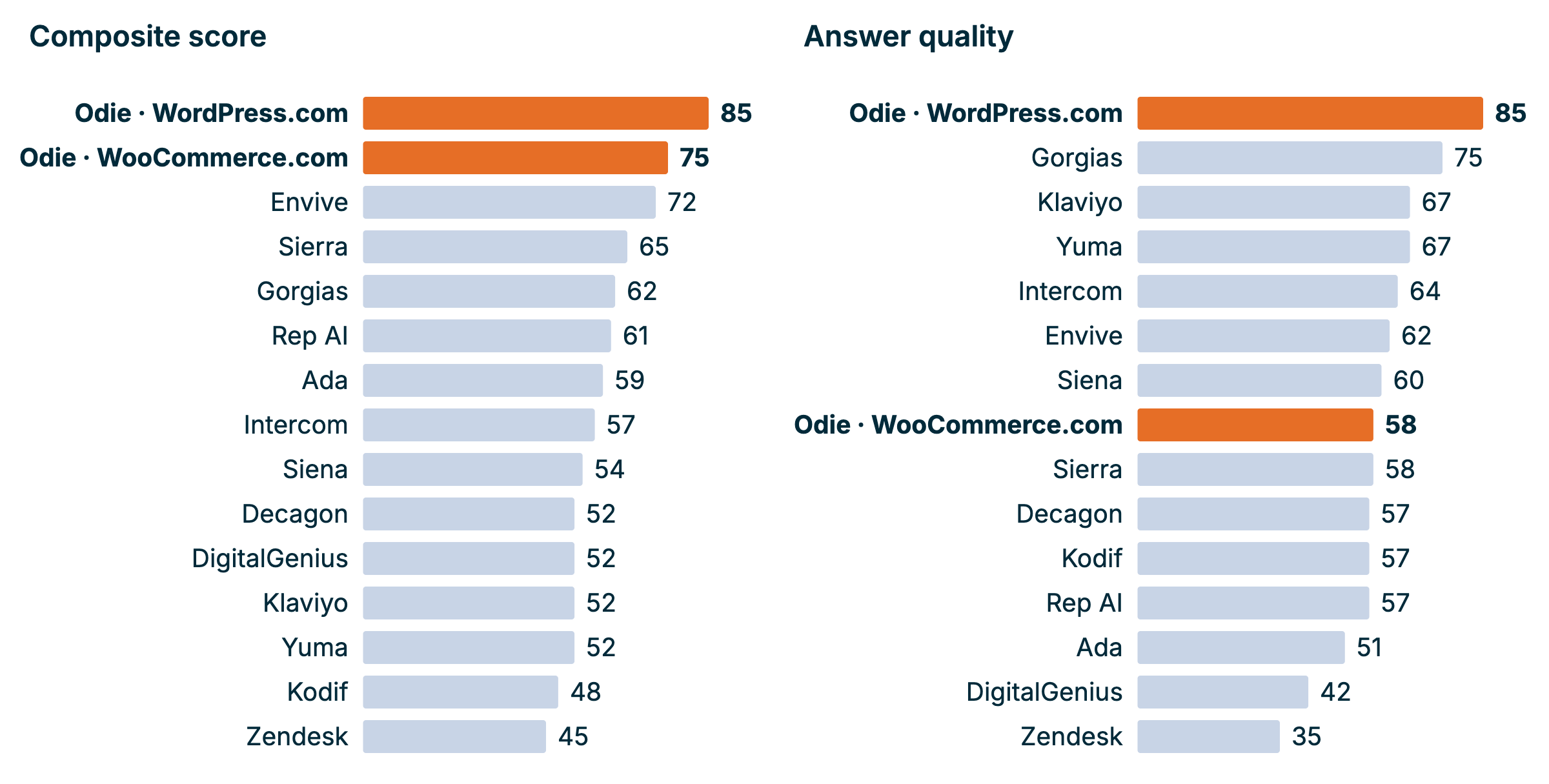
An October account names an AI Squad of Happiness Engineers responsible for reviewing Odie interactions. A later self-test compares scripted evaluations with manual review of real chats. A missing human handoff made the logged-out assistant's automation score look stronger, while real conversations exposed failures missed by the benchmark. These are scoped evaluation and ownership accounts, not company productivity results. (Meet Odie,benchmarking Odie.)
A separate October design-team reflection describes working prototypes helping alignment while polished output can still miss the real problem. That group observation does not replace Automattic's company-wide planning cadence. (Design-team reflection.)
37signals: prompt-first work with senior review
An October 5 engineering account describes Hot Cell built from written requirements with agent implementation, adversarial review, and production lessons feeding the library. This is a project-specific maintenance account, not an adoption rate or security guarantee. (Company account.)
In the July 2026 account on the Basecamp profile, DHH says most fixes and feature upgrades now start with a prompt. Designers and product managers can make an idea work on a branch and show it on a beta with real data. Ruby or JavaScript changes from a designer or junior programmer need a more senior review before merge; some generated code was discarded after creating technical debt. These are founder statements, not an adoption or productivity study. (REWORK, 1 July 2026.)
Fried also describes a larger menu of candidate work as a reason to limit how much the product changes at once. Faster implementation did not remove the need to choose. (Same episode.)
A January founder conversation adds internal security-report triage and on-call or performance investigation. It also discusses applying AI to production-access log reviews. These are dated founder-reported examples; they do not establish a measured company-wide use rate or savings. (REWORK, 21 January 2026.)
Todoist: shared context through DoistOS
The Todoist profile documents the April 2026 launch of DoistOS. Chase Warrington, who led the launch squad, describes a shared AI workspace connecting internal tools, company context, and reusable workflows through plain language. He describes a company-wide launch. This is an employee account of availability, purpose and examples of use; it supplies no measured workforce-wide use rate, output-quality evaluation or time-saving result. (Warrington.)
GitLab: platform and functional ownership
GitLab’s profile separates the central platform from each function's priorities. Enterprise AI owns platforms, standards, and the interface to security, legal, and privacy. Each function has an AI Transformation Owner; champions help colleagues experiment and adopt the shared patterns. The handbook describes the intended model, not proof that every function follows it. (Enterprise AI.)
Its September 2026 training account combines a self-assessment with role-specific learning paths. Daily interactions with the primary internal coding tool rose 22.3% one month after AI Ladders launched. The post does not name the tool, sample, or comparison group. It measures activity, not a productivity gain. (AI fluency playbook.)
More detailed guidance distinguishes personal experiments from canonical shared agents: function-level promotion needs its AI Transformation Owner, while company-wide work needs the hub. Repository skills have review owners and version history. The handbook distinguishes intended ownership from technical controls and lists settings still to verify. Authors also remain responsible for checking AI-assisted communication. (Platform mapping,communication guidance.)
Linear: agents work inside the issue
An April 2026 account on the Linear profiledescribes engineers delegating a first pass to an agent while keeping the issue assigned to themselves. A coding agent reviewed every pull request, with a human engineer giving final approval. Customer Experience and product managers also use agents to scope issues, group requests, and draft specifications. (How we use Linear Agent.)
A June account reports 50% more issues created and pull requests merged between January and March on one team. Another describes an unsuccessful attempt to fix every incoming bug, followed by two narrow automations that still require human review and merge. These are scoped operating accounts, not a company-wide productivity result. (Reviewing code,Teaching an agent to auto-fix bugs.)
An October account describes recurring security, code-cleanup and meeting-preparation workflows. Responsibilities expand in stages, using shared skills and ownership documents; people retain review. One customer-success workflow routes requests around staff availability. A separate September account shows that maintaining validation capacity requires infrastructure work as agent-assisted code volume grows. (Recurring delegation,CI maintenance.)
GitHub: agent work with human acceptance
A September 11 regional marketing account describes runbooks turned into Copilot instructions, campaign drafts approved by a person, and reviewed skills. A scheduled workflow also failed silently for five days. This is a team-specific review and maintenance example, not a company-wide adoption measure. (Regional marketing account.)
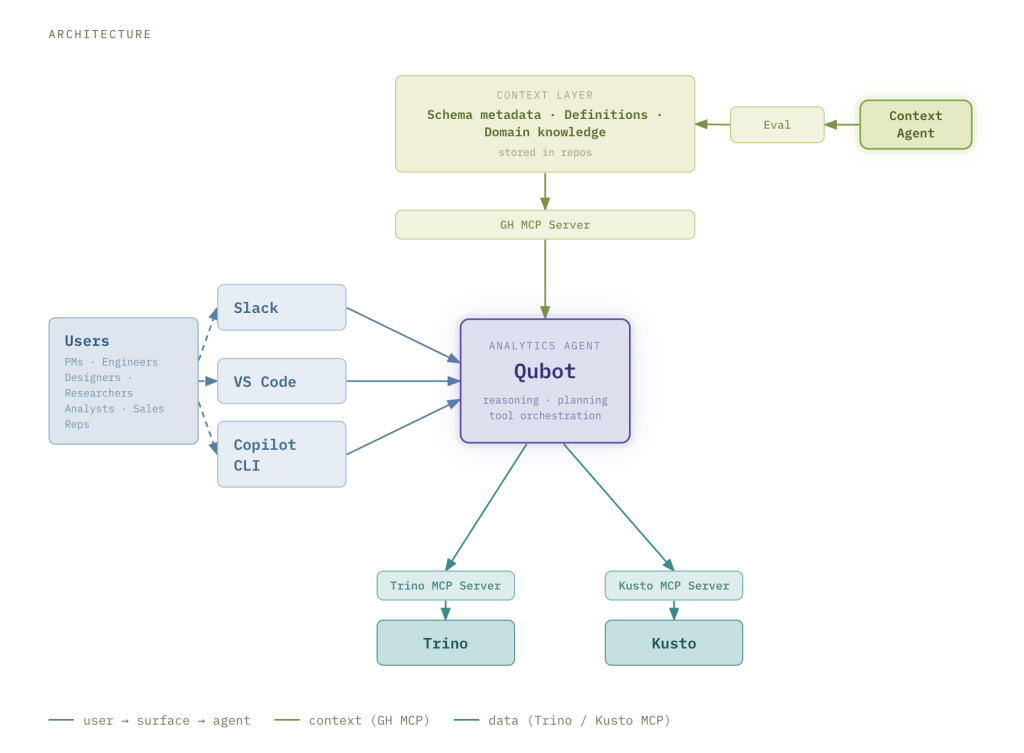
The GitHub profile now separates the dated CoreAI reporting transition from accounts of its own internal AI work. In a November 2025 account, engineers assign core-repository issues to Copilot, then accept, revise or close its proposed pull request. A June 2026 account describes Qubot, a shared internal analytics agent with team-owned context and evaluation gates. Its usage counts are activity, not a workforce adoption rate or productivity result. (Core-repository work,Qubot.)
An accessibility workflow adds human reproduction, triage and correction before work is routed. A separate runtime-migration account documents agent coordination failures alongside isolated worktrees and human integration decisions. Both remain scoped project accounts. October's issue-based access reviews are ordinary automation and are documented separately from AI use. (Accessibility,runtime migration,access reviews.)
Learnings
These follow from the profiles above. They are labeled inference where the profiles do not state them as a company practice.
- Usage is not an outcome. Zapier’s profile says its adoption percentages do not measure productivity. Shopify’s profile says River’s pull-request share and Quick’s site counts do not establish effects on hiring, retention, morale, or total productivity. Buffer’s Build Week numbers are event outputs.
- The nine accounts describe different changes.Inference. Access, a shared workspace, a review gate, functional ownership, and a hiring expectation solve different operating problems. Compare the mechanism and its limits; the record does not establish one adoption sequence or a ranking.
- Delegation still needs a review boundary.Inference. Shopify, 37signals, Automattic, and Linear give concrete examples of where a person reviews or approves work. Use those examples to specify who accepts a result in a local trial; they do not prove one approval rule fits every task.
- Name who carries the change after rollout.Inference. GitLab names platform and functional owners; Zapier connects fluency to hiring, onboarding, and performance. Their accounts justify examining ownership and reinforcement separately from access. They do not isolate which step caused an outcome.
One profile without internal operating evidence
The Wolfram profile does not document an internal AI operating practice. Its product descriptions and founder research do not establish how its own workforce uses those products.
Absence from a profile is not a claim that the company does not use AI. It is a claim about what this site has published. A practice gets added here when it is sourced on the company profile first.